Part 1: The Prologue
I had issues with my right hand and arm before. It would curl up—like I was having a stroke—followed by a week of pain and swelling. I saw various specialists, but to no avail. By the time I managed to get an appointment, the flare-up would be over. No traces, no aftereffects.
The movement tests, Nerve Conduction Studies, and CT scans showed nothing out of the ordinary.
Consequently, I was told it was “all in my head”—probably just stress. Because, apparently, stress makes your hand swell up like a balloon.
This carried on for a few years until I simply gave up. I stopped worrying; I assumed it was just a flaw in my makeup, a physical reaction to my job. I stopped seeing doctors, much like I ignored the buzzing in my ears—since apparently, that was “in my head” too.
I was tired of hearing that I was imagining it. The fact that my Medical Aid (health insurance, for those lucky enough not to know how ours works) stopped paying once my “day-to-day” funds dried up didn’t exactly encourage me to keep investigating.
In retrospect, I should have pushed. Maybe I would not be here, in this state, today.
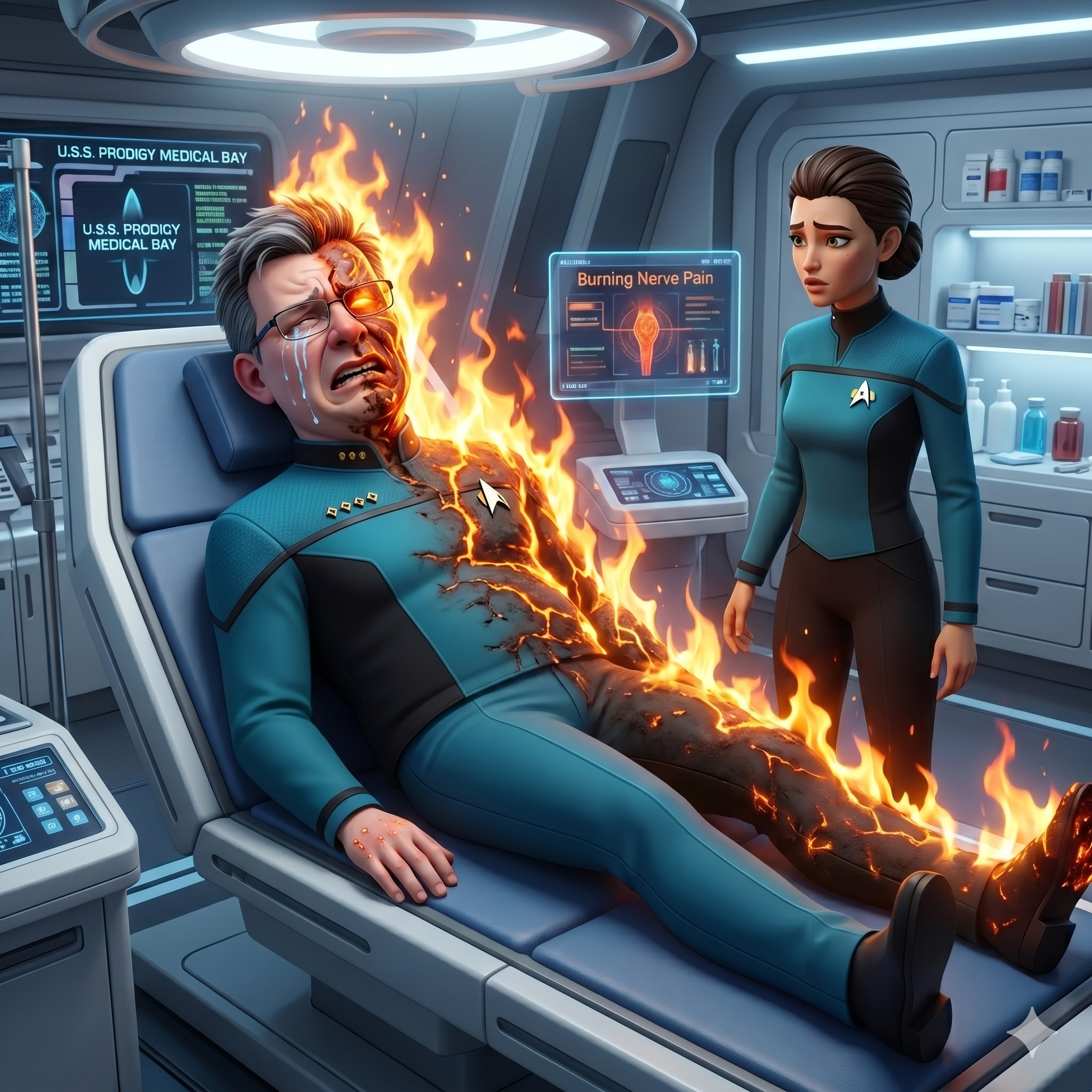
Anyway, my name is Pascal. I was diagnosed with CRPS (Complex Regional Pain Syndrome) 10 years ago, and this is my story.
Part 2: The Crash
It was December 2015. I had just finished a two-week stint in the hospital—don’t ask me why, I honestly can’t remember. It was probably my gastric system acting up again; I had been diagnosed with IBS years prior. I wasn’t a “frequent flyer” at the hospital, but my GP and I were definitely on a first-name basis.
Then, the hand routine started. I woke up with it curled and swollen, just as I had about twice a year for ages. I wasn’t particularly worried. It was annoying—and rather painful—but a cocktail of ibuprofen and paracetamol usually took the edge off. It wasn’t life-changing. Or so I thought.
This time was different. The “claw” persisted throughout December. I kept going to work, grateful when the offices finally closed between Christmas and New Year. I figured the “bonus” rest would fix it.
It didn’t. On the morning of my scheduled return to work, I got into a disagreement with my wife. The details are lost to the fog, but the result wasn’t. I stormed off to work, and as the adrenaline hit, so did the pain. It ratcheted up with every kilometer I drove in traffic.
Somewhere between the on-ramp and the office, I decided to detour to my GP instead. That decision marked the beginning of a lifelong journey.
My GP took one look at my hand and didn’t offer a lecture on stress. Instead, he organized an immediate appointment with a hand orthopedist located at the hospital. He asked if I could drive myself there.
Despite the state I was in, I said yes.
Part 3: The Verdict
To my amazement, the hand orthopedist saw me almost immediately. He ran through an array of movement tests and quickly came to a conclusion: this was not a bone or muscle issue. It was neurological.
He referred me to the neurologist on duty and admitted me to the hospital right then and there, warning me that an array of further tests lay ahead.
In the meantime, I called my wife to explain the situation. She was on her way immediately. I think both of us—and everyone around me—realised in that moment that we had drastically underestimated the situation throughout December.
I was waiting for a bed in the admission area when the lights went out. I collapsed.
When I came to, I was in a hospital bed in the ward. The “treatment” had already begun: a drip had been inserted into my right hand. Yes, the right hand. The hand that was twice the size of the left. The very reason I was in the hospital in the first place.
Needless to say, that was rectified promptly, but I still struggle to understand the thought process there. You would think a hand resembling a balloon might be a “Do Not Touch” sign, but apparently, veins are veins.
I waited for the neurologist until early afternoon, and then the battery of tests began: CT scans, X-rays, blood work, and the dreaded Nerve Conduction Study.
Everything came back clear. No breaks, no infections, no tumours. “Nothing out of the ordinary.”
But the ward remembers the Nerve Conduction test. And so do I. I screamed in such horrible pain that I probably traumatised the patients in the neighbouring rooms.
Based on the exclusion of everything else, my neurologist tentatively diagnosed me with CRPS. He looked at me and said, with brutal honesty: “There is little I can do for you.”
He tried his best to make me comfortable with painkillers and other medications, but the fix I was hoping for didn’t exist. His final instruction was a referral to an Occupational Therapist.
Part 4: The False Dawn
The following three months were a rollercoaster, culminating in a moment that would redefine “unexpected” for a healthy(ish), albeit stressed, 46-year-old.
My Occupational Therapist was a godsend. She was part physical therapist, part solution-architect, and—though she’d never charge for it—part psychologist. Her take on my condition was slightly different, however. She leaned towards a diagnosis of Dystonia.
At the time, this gave me a strange sense of comfort. Dystonia was treatable. Dystonia implied a mechanical glitch in the movement software, not a permanent wiring disaster. Most importantly, Dystonia wasn’t nicknamed “The Suicide Disease.”
We embarked on a regimen of mirror therapy, projection therapy, and other techniques used for dystonic conditions. Surprisingly, it worked. It wasn’t instant, and it took a hell of a lot of work, but for about eight weeks, I saw gradual improvement.
On the work front, I adapted. I bought dictation software so I could continue writing documentation—the core of my job—without needing to type. I was managing. I was coping. I thought I was winning.
Then came March.
I was at work when the pain spiked so violently that my body simply shut down. I collapsed. I don’t remember how long I was out, but waking up from that blackout marked the exact moment my life changed forever.
I went from believing my life would return to normal to realising, in a hazy, painful instant, that this was no longer an “injury.” It was a siege. It would take me months to fully process the magnitude of what happened that day, but the verdict was in: the battle wasn’t over. It had just begun.
Part 5: The Haze
My wife and mother came to collect me from the floor of my office, and it was straight back to the hospital.
At this point, I need to put a disclaimer on the narrative: the nine(ish) months that followed are less a linear memory and more a smear of impressionistic vignettes.
Here is what I know for a fact: I was admitted again. This time, the neurologist stepped up the medication aggressively—so much so that I became less of a human and more of a docile zombie. I never returned to work. We triggered the disability insurance process, which was an “adventure” of its own. I barely remember the details, only the crushing stress of bureaucracy colliding with a brain that was running at 10% capacity.
I slept. A lot. I continued seeing my OT, but the goals had shifted. I think she became desperate, or perhaps just realistic, because she stopped trying to fix the hand and started teaching me how to live without it.
I was no longer driving. I wasn’t really thinking. I was barely living. My existence became a loop: wake up, eat, rest, eat, sleep.
But my “Engineer” brain refused to shut down completely. To keep it from atrophying, I gamed. I stuck to strategy games like Civilization and Cities: Skylines—slow, thoughtful games that I could conquer with a mouse and one hand.
I also turned to LEGO. I built complex Technic sets as part of my therapy. It was officially about fine motor skills—coaxing my fingers to handle gears and pins—but really, it was a way to let the engineer in me build something in a world where everything else felt like it was falling apart.
Board games also became a staple of the house, introduced by my brother. We went from the simple-but-strategic Ticket to Ride to the heavy-hitting Terraforming Mars. These gatherings, organised monthly, became my lifeline. They kept me socially engaged when I had every reason to isolate.
My incredible wife and my mom took care of everything else, ensuring I survived the day-to-day. My
friends and brother showed up, never complaining, just being there.
It wasn’t much of a life, but I was alive.
Then came October, and with it, my father’s death. It wasn’t unexpected, and I won’t dwell on the sorrow of it here, but that loss triggered something deep inside me.
Part 6: The Awakening
My father’s death was a tragedy, but for me, it was also a mirror.
Years earlier, my youngest brother had died untimely, and my father had never truly recovered. He had faded into a shadow of himself, becoming a zombie of sorts—present, but absent. Grief had hollowed him out long before the end.
Standing at the precipice of his passing, I looked at him, and then I looked at myself. I saw the same fog in my own eyes. The medication had turned me into a passenger in my own life, just as grief had done to him.
I realised, with terrifying clarity, that if I stayed on this path, I would follow him into the grey and never come back.
I was not going to let myself go that way.
I decided to take control. Slowly, and without the official blessing of my doctors (note to the reader: this is not medical advice, it was an act of desperation), I started experimenting with my dosage. I needed to find the line between screaming pain and a comatose existence. Over the next two months, I fought to peel back the layers of sedation. It wasn’t easy, but I found a better balance. I reclaimed a sliver of life.
To seal the deal, I did something completely irrational. I bought a car.
And not a sensible, easy-to-drive sedan suitable for a man with one working arm. No, I bought a VW Scirocco R. A hot hatch. It was a pure impulse buy—aggressive, fast, and entirely unnecessary. But every time I looked at it, it reminded me that I wasn’t dead yet. I was still here, and I still wanted to go fast.
Part 7: The Adjustment
By the time I bought the Scirocco, my financial landscape had settled. The permanent disability claim was finally approved, and the monthly checks started arriving. This steady income meant my only significant debt was the car itself. This was my new reality: I wasn’t working, but I wasn’t drowning.
The car became my symbol of freedom. I drove it only when my body allowed, but knowing it was there—and that I could drive it—mattered more than the mileage.
My domestic life shifted, too. After my father’s passing, my mother moved in with us. This provided a vital safety net, but as anyone who has lived with a parent as an adult knows, it’s a dynamic that comes with its own friction. It was a blessing, but a complex one.
As my right arm became increasingly useless and the pain intensified, physical LEGO bricks became too difficult to manipulate. But the engineer in me refused to retire. I migrated to the digital realm, designing intricate LEGO sets using specialised CAD software. I spent hours rotating 3D bricks on a screen, building structures my hands could no longer hold. It kept my mind sharp and my days full.
Eventually, the financial reality checked in again. My disability income was reduced by 20%, and the math no longer worked. I had to sell the Scirocco. To my surprise, it didn’t crush me. A few years prior, that loss would have been devastating, but I was too busy in the little productive time I had to dwell on it.
And that brings me to a hard truth about this condition: time is different for us.
Chronic sufferers do not have the same “productive” day as everyone else. We don’t start with a full battery. Most of our energy is burned silently, just managing the pain and the body itself. If I get five hours of productivity in a day, that is a rarity—a miracle, really. Usually, it’s far less. We live in a micro-economy of energy, where every action has a cost.
Then came 2020. The world stopped, the virus arrived, and a new chapter opened.
Part 8: The Lockdown Paradox
The arrival of the virus brought a strange duality with it: some changes were good, others were terrible.
Let’s start with the good: for the first time in forever, my wife was home all the time. The bad: by April, she had lost her job.
But there was a saving grace. For years, the specifics of my career had been buried under strict Non-Disclosure Agreements (NDAs), but friends knew the headline: I knew the e-Commerce space inside out.
With businesses scrambling to go digital, requests started trickling in. Could I help them get online? My health meant I couldn’t commit to the grind, but I realised we had a solution closer to home. I could be the consultant, and my wife could be the executor. I could teach, and she could build.
So, we started a small business. It carried us for nearly two years. While I provided the architectural guidance where I could, I want to be clear: she did the heavy lifting. It gave us an income, but more importantly, it gave us a shared purpose during a time of global stagnation.
That same year, tragedy hit my wife hard. Her mother passed away in April. It wasn’t unexpected—she had been suffering from Alzheimer’s—but grief is never strictly logical, and losing a parent during the isolation of 2020 left a deep mark.
But in the end, 2020 wasn’t a terrible year for us. We didn’t catch COVID. We survived. All things considered, we held the line.
2021 brought a stabilisation of our new normal. My wife transitioned into a part-time job working from home, and I carried on managing my bio-rhythms. Surprisingly, my condition seemed to hit a plateau—in a good way. I regained a tiny amount of mobility in my hand.
It wasn’t a cure, but it was enough to hold a pen or use a screwdriver for short bursts. To an outsider, turning a screw is a mundane task. To me, that little spark of function was a revelation. I managed that spark the best I could, and suddenly, possibilities that had been closed for years cracked open just a sliver.
I thought I was turning a corner.
But it was the following year, 2022, when things would start going off the rails again.
Part 9: The Social Experiment
Throughout 2021 and 2022, fuelled by that tiny spark of improved mobility, I made a decision. I wanted to be in the world again.
I started assisting a friend at his restaurant. Initially, it was just helping out, but it eventually evolved into working Front of House on Friday and Saturday evenings—strictly when my body allowed.
For a brief season, this was my salvation. It forced me out of the house and gave me a tangible purpose. I built relationships with customers and staff, and for a few hours a week, I wasn’t “Pascal the Patient”; I was just a guy running the floor. It was exactly the distraction I needed.
But CRPS is a jealous companion. If you ignore it for too long, it reminds you it’s there.
In 2023, the house of cards came crashing down. It started with my leg—a new, ominous pain that began to mirror my arm—but before I even had time to process that, my internal chemistry decided to revolt.
Part 10: The Medical Cascade
I had complained to my GP about a general increase in body pain early in the year. He opted for a “full house” blood panel, and behold! The results flagged Polycythemia (a condition where the body produces too many red blood cells).
This was quickly confirmed by a haematologist. The treatment? Good old-fashioned bloodletting. I began donating half a litre of blood on a regular schedule to thin out the sludge in my veins.
But in medicine, there is rarely a “single” issue. The investigation into the Polycythemia led to a sleep study, which revealed severe Sleep Apnea. My brain was starving for oxygen at night, which was triggering my bone marrow to panic and overproduce red blood cells.
The solution was simple: a CPAP machine. The execution was impossible: my Medical Aid refused to cover it.
Yes, you read that correctly. My insurance refused to pay for a life-saving device—one that would prevent strokes and heart attacks—leaving me to foot the bill for an expensive piece of hardware. I could write a full dissertation on the short-sighted economics of health insurance, but I will spare you the rant.
Suffice it to say, the Sleep Apnea and Polycythemia are now under control. But just as I was putting out those fires, I lost my captain.
My long-time neurologist retired. I was forced to go “doctor shopping,” a terrifying prospect for any chronic pain patient. I saw a specialist who came highly recommended, but that appointment turned into a catastrophe.
He admitted me to the hospital for a week of investigation. His conclusion? It was all in my head.
Despite two previous neurologists confirming the CRPS diagnosis (one of whom was university-affiliated), and despite ten years of documented history, this doctor decided he couldn’t find “proof.” Therefore, the pain didn’t exist. I had heard horror stories of this kind of dismissal, but I never thought, a decade into this journey, I would be the one hearing it.
To add injury to insult, one of his investigative tests was a Lumbar Puncture to check my spinal fluid. To this day, I am convinced something went wrong during that procedure. A new, sharp, permanent pain is now present in my back—a parting gift from the doctor who didn’t believe I was in pain to begin with.
I fired him.
In a twist of fate, a new neurologist eventually moved into the very rooms my old doctor had vacated. I decided to give him a chance. He is now part of “my” medical team, and sanity has been restored.
But the damage to my leg? That was just getting started.
Part 11: The Retreat
By early 2024, the reprieve was over. My leg wasn’t just “bad”; it was degrading rapidly. I had to stop working at the restaurant. I simply could no longer handle the physical demand. That small window of social connection and purpose slammed shut.
Then came the “gift” from my previous neurologist. The sharp pain from the lumbar puncture didn’t stay in my back; it radiated down into my right leg, adding insult to injury. My new neurologist assured me this couldn’t be the CRPS spreading, but I remain skeptical. When you live in this body, you know when a fire is jumping the firebreak.
He referred me to two orthopaedic specialists: one for the knee, one for the foot.
I will concede that the knee issues are mechanical at their root—a lifetime of wear and tear. The specialist’s solution? Physiotherapy and weight loss.
Ah, the classic medical paradox. “Great. Lose weight.” How exactly? I can’t exercise without triggering a pain flare that leaves me bedridden. Walking from my study to my bedroom has become a marathon experience, yet the prescription is to run laps.
The foot specialist was slightly more logical, though equally ineffective. He noted my flat feet and sent me to a podiatrist for new insoles. He admitted the rest of the clinical picture was “murky” and hoped the soles would be the magic bullet. Spoiler alert: they weren’t. But we will get to that.
Just as I was adjusting to this new level of limited mobility, my body threw a curveball.
Toward the end of the year, I was hospitalised urgently with a severe gallbladder infection. The infection was so advanced that I lost a week of memory. I don’t remember the first seven days in High Care; I was so “out of it” from the infection and the pain management.
The surgery was performed by a highly skilled surgeon, and my gallbladder was evicted. I spent another week in High Care stabilising before I could even think about going home.
But there was a silver lining to this septic cloud: I officially met my Physician (Specialist Internist). He had treated me briefly before at the request of my haematologist, but this crisis cemented our relationship.
I now had a trusted Neurologist and a trusted Physician practicing in the same hospital.
To a healthy person, getting excited about doctor logistics sounds insane. But to a chronic patient, knowing your “team” is under one roof and actually talking to each other? That is a victory.
Part 12: The Siege
And finally, we arrive at the last year. All I can do is shake my head, though I suppose I must admit there is some movement in a positive direction. Even if it feels like walking through mud.
The year began with a devastating exit. My father-in-law, a man whom my wife and I were both incredibly close to, decided to bow out of this world in the first week of January. We were lucky enough to see him the day before, but the loss was catastrophic for my wife. He wasn’t just a stepfather—he was her father. He was also her employer. In one week, she lost her parent, her job, and her anchor. With no other family in South Africa save for me, the isolation was palpable.
7To add to her woes, I was becoming less of a partner and more of a dependent. My leg issues had deteriorated to the point where “going out” became a logistical puzzle. If we went to a shopping centre, we were fine—they have wheelchairs. But conference centres or other venues? Not so much.
We did the logical thing and applied to the Medical Aid for a wheelchair. And behold, the answer was a resounding, familiar “NO.” I was getting tired of hearing that record, to be honest. But I didn’t have the energy to fight the stress of an appeal.
I paid for that lack of energy in August.
I ended up in the hospital again, admitted as a “Code Red.” My blood pressure was 220 over 160, and my pulse was frantic. For those not in the medical field: those are stroke numbers.
When the dust settled, my Physician took over. We had a serious discussion. I told him, in no uncertain terms, that I wanted him to lead the team. It was not negotiable. I needed a captain for this sinking ship.
He agreed, and we started peeling back the layers. First, we stabilised the blood pressure. Then, we tackled the leg and foot pain. Blood tests revealed that my Chromogranin A levels were sky-high. We still don’t know why—a mystery that requires a PET Scan and a Gastroscopy/Colonoscopy to solve in the near future.
To manage the immediate agony, I underwent nine nerve blocks during my stay. Nine needles to reset the wiring.
The results have been a mixed bag. Oddly enough, the blocks didn’t wear off where I expected. The block in my right arm—the original villain of this story—is actually holding. It has allowed me to use my hand more frequently than I have in years. But the leg blocks? They have already faded, leaving me back on shaky ground.
And so, the fight with the Medical Aid continues. It has moved past frustration and into the realm of the ridiculous.
Part 13: The Epilogue
Earlier this year, my GP sat me down and revisited the “weight” conversation. But this time, the tone was different. He told me that shedding weight was no longer negotiable for my joints and general health.
Before I could launch my usual protest about the impossibility of exercise, he handed me a prescription for Ozempic.
“Let’s try,” he said. “You have nothing to lose.” (Except the weight, presumably).
It is a new variable in the equation, and we will see how it plays out. As for the mystery of the high Chromogranin A levels, I will be booking the Gastroscopy, Colonoscopy, and PET Scan in short order—just as soon as my current war with the Medical Aid is resolved.
I am writing this from the trenches, ten years in. My journey with CRPS is far from over, but I have gathered some intelligence along the way. These are not medical recommendations; they are simply the truths I have paid for in pain:
- The Volatility Rule: CRPS is an incredibly dynamic condition. I can be fine in the morning and completely incapacitated by the afternoon. Actually, that’s a lie—I can be fine now and in agony ten minutes from now. Oddly, the reverse is also true; the pain can lift as suddenly as it arrives.
- The Energy Mandate: If I need to rest, I do so. My body knows better than my schedule. Pushing through usually results in a crash that costs me days, not hours.
- The Stress Multiplier: Emotional stress is physical pain. They are directly linked. Any disagreement or anxiety spikes my pain levels almost instantly.
- The Medication Reality: Medications wear out. Tolerance is real. The only one that hasn’t lost its efficacy so far is Oxycodone. I am incredibly careful with it due to its addictive nature, but we have reached a point of brutal pragmatism: I would rather be dependent than be in screaming pain.
- The United Front: I needed to build a core team of trusted medical professionals under the same roof to start getting results. Disparate specialists who don’t talk to each other are a liability.
- The Bureaucratic War: Medical Aids are useless unless you face them dead-on and force their hand. It is a full-time job, but passivity guarantees a rejection. I am in the process of forcing their hand as I write this.
- The Expert Patient: I do not let myself be gaslit. After a decade, I know my body better than my doctors do. I remind them of that from time to time—politely, but firmly.
- Vigilance: New pains should never be dismissed as “just the CRPS.” If I had ignored the back pain or the blood pressure, I might not be here writing this.
This has been my last ten years. And tomorrow, I’ll wake up and handle whatever the eleventh year brings.
Never give up. Never surrender. We are CRPS warriors.





One Response
So Sorry My Friend. Hopefully some long term help is found and things take a turn for the better. Fingers Crossed for the Future. 🙏🙏🙏👍👍👍